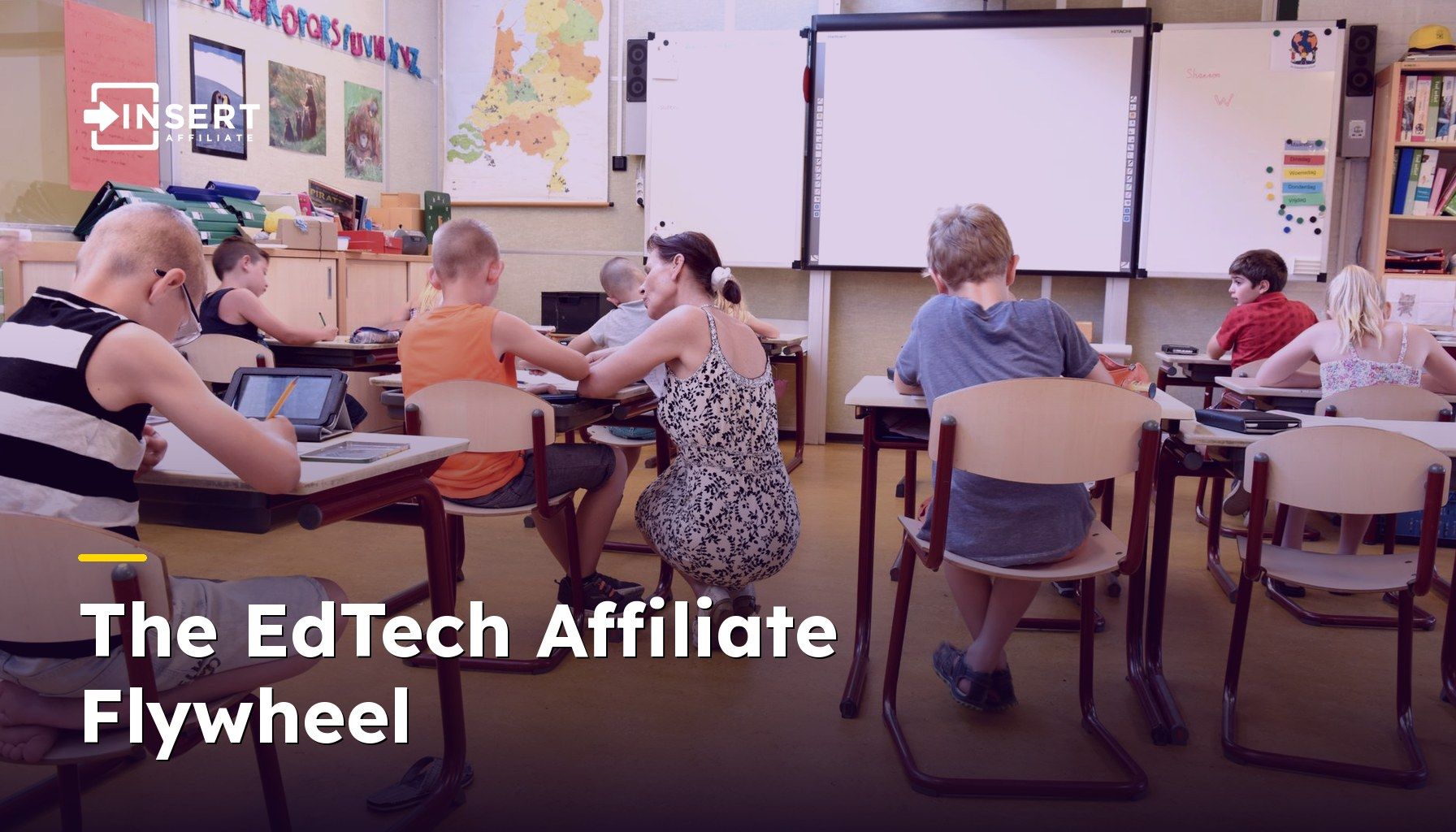
A single affiliate referral in education does not produce a single user. It produces a classroom, a school, and eventually a district, because education apps spread through institutional networks that multiply every referral many times over.
This is the edtech affiliate flywheel, and it is the reason education apps that invest in affiliate programmes grow at rates that paid acquisition alone cannot match.
How the Flywheel Works
Traditional affiliate marketing is linear. An affiliate shares a link, a user clicks it, and one person installs the app. The ratio is roughly one referral to one user.
Education breaks this pattern. A single referral into an education network triggers a chain of adoption events that are structurally different from any other app category.
Here is the sequence. An education blogger reviews your reading comprehension app and includes their affiliate link. A fourth-grade teacher reads the review and installs the app to evaluate it. She finds it useful and assigns it to her class of twenty-eight students. Those twenty-eight students install the app at home, and their parents see what they are using. Three of those parents mention it to teachers at other schools. Two of those teachers try it and assign it to their own classes.
From one affiliate link click, you now have three classrooms of users, roughly eighty to ninety installs, generated through a chain reaction that required no additional marketing spend. The affiliate who wrote the original review earned a commission on the teacher's subscription, but the downstream growth was a structural bonus that came free.
Why Education Networks Amplify Referrals
Three characteristics of education make this flywheel possible.
Mandatory adoption dynamics: When a teacher assigns an app, students do not choose whether to install it. It is a requirement. This is fundamentally different from a fitness influencer recommending a workout app, where each follower independently decides whether to download. In education, one decision-maker drives dozens of installs.
Peer networks among educators: Teachers talk to each other constantly. They share resources in staff meetings, professional development sessions, department group chats, and conferences. Research shows that 89% of teachers use edtech tools, and mentoring programmes increase adoption by 40%. When one teacher in a school adopts your app, the probability of adjacent teachers adopting it rises sharply.
Institutional procurement patterns: Schools and districts do not buy tools one seat at a time. When an app proves effective in one classroom, administrators evaluate it for school-wide or district-wide deployment. A single affiliate-driven teacher trial can lead to an institutional purchase of hundreds or thousands of seats.
Mapping the Flywheel Stages
The edtech affiliate flywheel has four distinct stages, and understanding each one helps you optimise for maximum spin.
Stage 1 - Affiliate Activation: An affiliate, whether a teacher, education blogger, tutor, or curriculum consultant, shares their unique link or short code with their audience. Insert Affiliate generates these links and tracks attribution at the device level across iOS and Android, so every downstream install from this initial share is correctly attributed.
Stage 2 - Classroom Multiplication: The first user to convert is typically a teacher or administrator. Their adoption decision immediately multiplies into the number of students in their class or school. This is the multiplication event that makes education affiliates so valuable. A single affiliate conversion can represent twenty to thirty actual users.
Stage 3 - Network Propagation: Students tell parents, parents tell other parents, teachers tell colleagues, and administrators tell their counterparts at other schools. Each of these conversations is a potential new entry point into another classroom. Your affiliate programme should make it easy for these secondary advocates to become affiliates themselves, creating new tracked referral sources at every node in the network.
Stage 4 - Institutional Adoption: When enough individual classrooms in a school or district are using your app, the conversation shifts from individual subscriptions to institutional licensing. This is the highest-value outcome of the flywheel, converting grassroots adoption into enterprise contracts.
Designing Your Programme for Flywheel Effects
Not every affiliate programme generates flywheel dynamics. You need to design for them deliberately.
Commission structure: Use recurring revenue share commissions paid in cash via Stripe. When affiliates earn ongoing income from every active subscription they referred, they stay engaged over the months and years it takes for the flywheel to fully spin up. One-time payouts kill the flywheel because affiliates lose interest after the initial conversion.
Multi-tier attribution: The flywheel depends on tracking referrals through multiple layers of the education network. Insert Affiliate supports daisy chain commissions, meaning if Teacher A refers Teacher B, and Teacher B refers Teacher C, the attribution chain is preserved and commissions can be structured accordingly. This incentivises your existing affiliates to recruit new affiliates, accelerating the flywheel.
Low-friction signup: Affiliates sign up through your programme's signup page and receive their unique link immediately. The faster a motivated teacher can go from hearing about your programme to sharing their link with colleagues, the faster the flywheel spins. Every hour of delay is a lost recommendation.
Classroom-ready sharing tools: Provide affiliates with QR codes, short codes, and printable materials that work in classroom settings. Digital links are useful for email and social media, but a QR code on a printed handout is how apps actually spread inside schools.
The Compounding Math
The flywheel is powerful because its effects compound over academic cycles.
In Year 1, you recruit fifty teacher affiliates. Each one assigns your app to an average class of twenty-five students. That is 1,250 student users from fifty affiliate conversions, a 25x multiplication factor. Of those fifty teachers, ten mention your app to colleagues, generating another twenty teacher adoptions and five hundred more students.
In Year 2, your original fifty teachers have new classes. Another 1,250 students. The twenty secondary teachers refer ten more. The flywheel is now generating users from referral chains that are two and three layers deep, all tracked back to the original affiliates through your attribution system.
By Year 3, you have a self-sustaining growth engine that produces thousands of users per academic cycle with minimal incremental cost.
Measuring Flywheel Velocity
Track these metrics to understand how fast your flywheel is spinning.
Multiplication factor: How many end users does each affiliate conversion generate? In education, this should be significantly higher than one-to-one. If your multiplication factor is below ten, your classroom adoption mechanics need work.
Network propagation rate: What percentage of your teacher users refer at least one colleague? This measures how effectively your app spreads through professional networks.
Time to institutional conversion: How long does it take from the first affiliate-driven classroom adoption to a school-wide or district-wide purchase? Shortening this timeline dramatically increases the flywheel's revenue impact.
Affiliate recruitment from users: What percentage of your users become affiliates themselves? The flywheel is healthiest when the line between user and affiliate is blurred, when every teacher who loves your app is also earning from recommending it.
Building the Flywheel
The edtech market has surpassed $200 billion globally, and mobile education apps represent one of its fastest-growing segments. The structural dynamics of education networks, where one decision-maker drives adoption for dozens of users, make affiliate marketing disproportionately effective compared to other app categories.
Insert Affiliate provides the infrastructure to build and track the flywheel. The SDK integrates with iOS, Android, React Native, Flutter, and Unity apps, and works with RevenueCat, Adapty, Apphud, and Stripe for subscription tracking. Commissions are paid in cash via Stripe, and daisy chain attribution preserves the referral chains that make the flywheel spin.
One referral. One classroom. One school. The flywheel only needs to start once.